
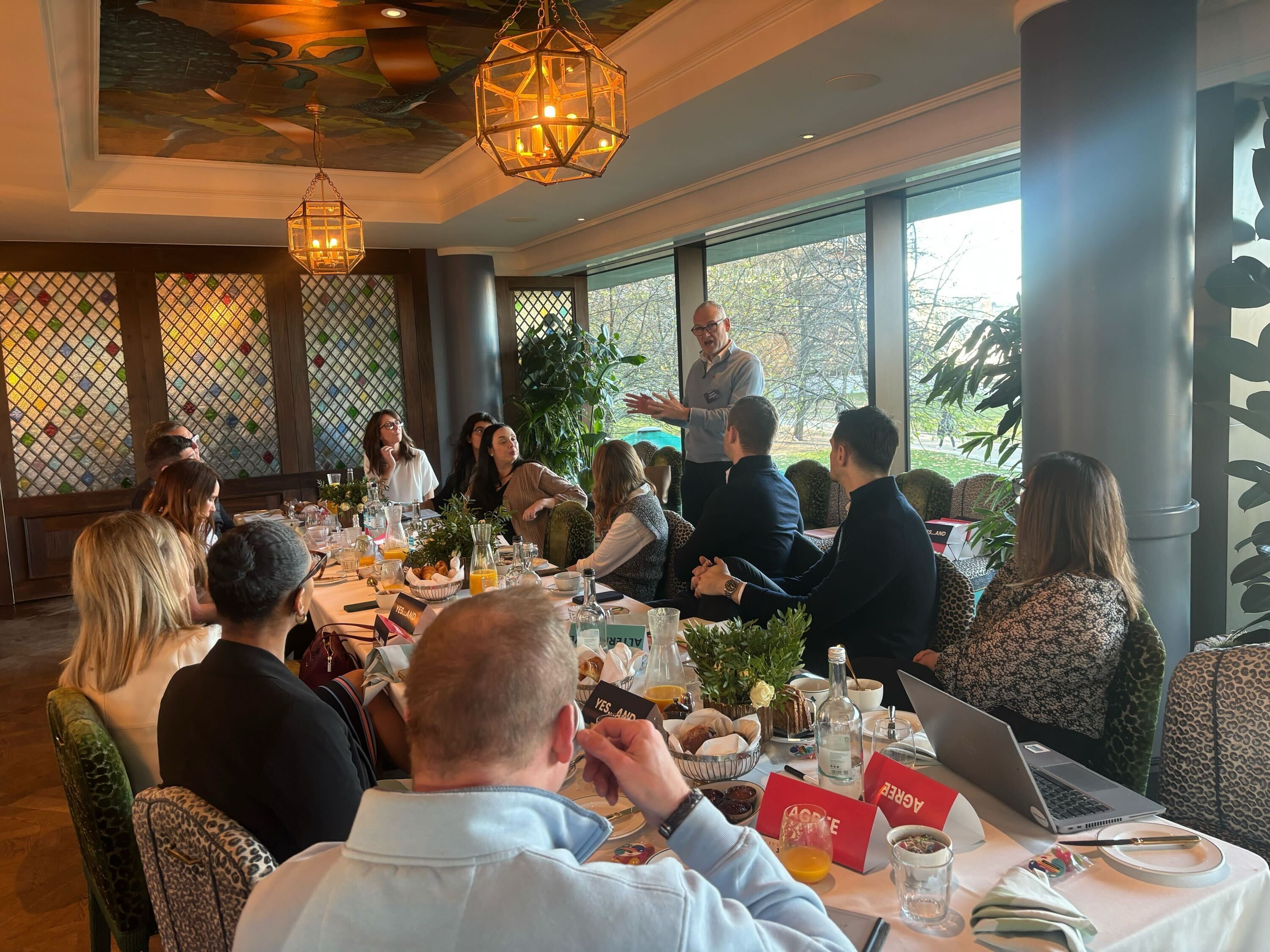
Our central provocation for the morning was simple but urgent:
‘As high application volumes collide with shrinking entry-level opportunities and a shift to skills-based hiring - what radical innovations will future-proof early careers pathways while maintaining fairness of opportunity?’
What followed was open, candid and energising. This is a summary for other Early Careers and Talent Leaders, because the conversation is one the whole industry needs to be part of.
1. A system under strain, but ripe for change
Stephen Isherwood from ISE set the tone: vacancies are falling, confidence is wavering, and application volumes are climbing so steeply that as a sector we’re likely to send 5m rejection emails this hiring season. It’s no wonder teams are under strain and students are feeling demoralised.
AI tools now enable candidates to bulk apply at the click of a button, and over 99% are rejected. Employers are increasingly using AI to manage this, raising the question: are recruiting processes still fit for purpose?
As Susie Major from AMS put it, we risk breaking the social contract with young people if mass rejection continues at this scale without any additional support on alternative pathways into the workforce.
Stories of organisations scaling back junior hiring due to AI efficiencies are also emerging. But as Stephen pointed out, this narrative doesn’t fully reflect reality. Many large organisations remain committed to early talent, and headlines often oversimplify. What we do know is that emerging technologies are changing skills needs, making workforce planning harder at the same time the cyclical nature of Early Careers hiring demands predictability.
If we were to rip up Early Careers pathways and design a model for the next 10 years - is the current model what we’d come up with? Most would agree no - but without the option to start from scratch and with little to suggest that policy change or funding will appear fast enough to provide a solution, we need to look at options for cross industry collaboration to drive the innovation that's needed.
2. The next generation has already changed the rules: Are early careers pathways keeping up?
Karen White from Springpod shared insights on behavioural trends shaping Gen Z and the fast-approaching Gen Alpha. These generations are formed by cost-of-living pressures, early exposure to technology and a very different relationship with work.
Over 60% say financial factors shape their career decisions, and many think seriously about their futures as early as 13. Their choices are driven less by prestige and more by a ‘trifecta’ of money, meaning and wellbeing. Wellbeing is central: 46% of Gen Z report feeling stressed or anxious most of the time, and they expect employers to take this seriously through culture, workload and flexibility.
They are also turning to new sources of support, with one in four acting on AI-generated career advice, and their digital fluency continues to accelerate. 53% of Gen Z juggle freelance projects, and Gen Alpha who were raised among creators, online entrepreneurs and AI may embrace portfolio careers even earlier. Expectations around autonomy, flexibility and values alignment are reshaping employer brands, with 45% rejecting employers whose beliefs don’t match their own.
As a result, the traditional degree-then-job pathway is unlikely to remain the central entry route. Young people are gravitating toward blended routes, fluid experiences and stackable learning that build skills rather than credentials.
With 44% of UK businesses reporting skills gaps, employers are under pressure to rethink talent entry. If organisations limit access through degree-only gateways or roles that restrict side projects, they risk missing emerging talent segments.
Meanwhile, 93% of Gen Z use AI tools weekly. For Gen Alpha, AI-augmented work will simply be normal, meaning pathways must reflect a world where skills evolve quickly, careers stack horizontally, and young people expect tools, not training wheels.
The group agreed that when a system reaches this level of strain, it forces us to lift our heads above the day-to-day and ask the bigger questions: will current approaches truly serve future talent and the adaptability businesses need to stay agile? And in that lies opportunity…
If 39% of skills are expected to transform by 2030, should early career schemes become reskilling engines rather than pipelines to yesterday’s job descriptions?
If Gen Alpha expects multiple careers, income streams and side projects, how do pathways make that a feature?
As one participant put it:
‘This is our industry, it’s on us to shape it…’
3. Thinking beyond the industry’s ‘policing’ of AI
AI dominated the discussion because of ongoing ambiguity. Leaders are seeing more generic, AI-generated applications and less genuine insight. Students are turning to AI because competition feels overwhelming, while employers struggle to distinguish ‘AI-polish’ from ‘AI-manufactured’ applications.
As leaders noted: ‘Students previously conducted deep research; now many use AI, leading to lower-quality, generic applications.’ and ‘Students feel competition is so high that they rely on AI to upskill applications.’
The consensus was clear: the industry needs to stop viewing AI mainly as a policing challenge. Instead, we should help students use it well, guiding them on ethics and integrating AI into pathways that build confidence. With AI skills now relevant across most roles, the question becomes: how do we create processes that work with AI? And alongside that, how do we help young people better recognise the skills they already have?
There was conversation on the need to develop stronger critical thinking - a skill that becomes even more important as AI use grows. Young people need to build these human-centred, transferable skills as job roles evolve faster than ever. For organisations, this means adapting quickly and creating experiences that help talent develop the skills the future workforce will demand.
4. No going back - Gen Z and Gen Alpha are redefining career pathways
The group discussed that there will need to be increased consideration that Gen Z and Gen Alpha simply don’t see careers and learning in the way many employers still design them. Many assume they’ll have side hustles, multiple careers, digital income streams and periods of pivoting.
Young people are growing up in a world where creators, freelancers and micro-entrepreneurs are normal. More than half of Gen Z already juggle freelance work, and Gen Alpha may take this further. This isn’t just preference, it's also necessity, shaped by cost-of-living pressures, job instability and accessible online opportunity.
They are values-driven, transparency-driven and attuned to wellbeing. Many will decline an employer if the culture doesn’t feel aligned. Several attendees shared examples of students challenging brand presence at fairs or choosing alternative pathways based on autonomy and flexibility.
The takeaway was clear: if this generation is already navigating careers in fluid, non-linear ways, then early careers pathways must evolve from fixed-entry routes into experiences that flex with how people actually move through work. The question is no longer whether this shift is coming, but how quickly employers can adapt.
5. Skills and readiness gaps are widening
There was strong agreement that the readiness gap is widening. Students have less workplace exposure, less clarity about roles and more anxiety. Post-Covid behavioural shifts were widely observed.
European comparisons were illuminating. The Netherlands and Germany embed readiness deeply through education–employer collaboration. The UK, by contrast, often leaves students to bridge the gap themselves.
The group recognised that the solution isn’t about adding pressure to the funnel, it’s about exploring ways to expand access to meaningful, applied learning that helps young people practise problem-solving, demonstrate capability and build confidence long before they apply.
6. Fairness is the foundation
Fairness and accessibility was at the forefront of conversation. Recognising that with almost a million young people categorised as NEET, leaders raised concerns about accessibility, awareness and barriers such as travel, confidence and social capital.
Several described situations where students didn’t understand job titles or entire sectors unless someone at home explained them. Traditional work experience is often inaccessible or doesn’t reflect real work and add genuine career ready skills.
There was broad agreement that fairness must be designed into pathways from the start through digital access, early exposure, transparent language and deeper collaboration with Higher Education to embed workplace readiness at scale.
7. Reality check - Teams are stretched and budgets tight
Every table acknowledged the reality: despite agreement and a lot of good will - resources are constrained, expectations rising and teams are being asked to do more with less.
So evidencing the ROI of Early Career programs will be more important than ever, as will embracing innovation and opportunities to engage talent in new ways. Over the next few years organisations are likely to continue needing deeper skill-building, more experiential learning, stronger employer–university collaboration and fairer access.
So pathways must become more fluid, agile and with heavy reliance on digitally enabled approaches to meet that need.
So, what now?
The leaders around the table agreed the system is fraught and the pace of change with AI is driving organisations to adapt quickly, creating opportunity for reinvention. Generational shifts are changing expectations faster than employers may be ready for…
Traditional pathways aren’t disappearing, but they can’t remain the only entry route. This generation wants freedom, fluidity and the ability to test, build and showcase their skills in different contexts.
The future belongs to organisations willing to experiment with stackable, agile skills-led models at scale, creating pathways that truly reflect the diversity of emerging talent over the next decade.
Who was there?
Springpod: Karen White (Early Careers Lead)
Springpod: Jon Mallott (Strategic Partnerships)
Springpod: Andy Dillow (COO)
Springpod: Oliver Fisher (Co-Founder)
Shell - Claudiu Badea - Early Careers Lead
JLL- Sarah Isikitan - Director Early Careers
Morgan Stanley - Kerry Vanslembrouck - Head of Early Careers
Visa - Daniel Farrar - Head of Early Careers
Major Global Entertainment Company - Early Careers Manager
Kema Davis - Global Early Careers Lead - Hiscox Insurance
Clare Tomkins - Global Head of Early Careers - Atlassian Williams F1
Stephen Isherwood - ISE
Susan Major - AMS
Nicky Brimmer - Form1
Ross Anderson - Form1