
Over the past few years, Siemens has evolved far beyond its engineering roots. Today, it leads major digital transformation projects for customers through a mix of its own technologies – software and hardware – alongside consultancy. The growing complexity of these technologies means that skills are paramount. The kind of skills Siemens values is shifting too. A traditional, linear recruitment process that sorts people via CVs and static lists of “must haves” simply doesn’t fit that reality anymore.
That’s where the partnership with Springpod and Arctic Shores came in.
Together, the three organisations have redesigned the way Siemens attracts, assesses and supports early talent. The goal isn’t just to fill roles faster, it’s to build a fairer and more future ready pipeline, while delivering genuine social impact.
Why the old model stopped working
Inside Siemens, there was a growing recognition that the existing approach was creating more problems than it solved.
On one hand, long lists of technical skills were becoming out of date almost as soon as they were created. By the time a young hire had joined, completed their onboarding and found their feet, the tools and technologies they’d been recruited for could already be shifting.
On the other hand, the process was quietly filtering out exactly the people the business said it wanted to reach. Young people without polished CVs or professional networks, particularly those from lower socio-economic and global majority backgrounds, were less likely to get a fair hearing.
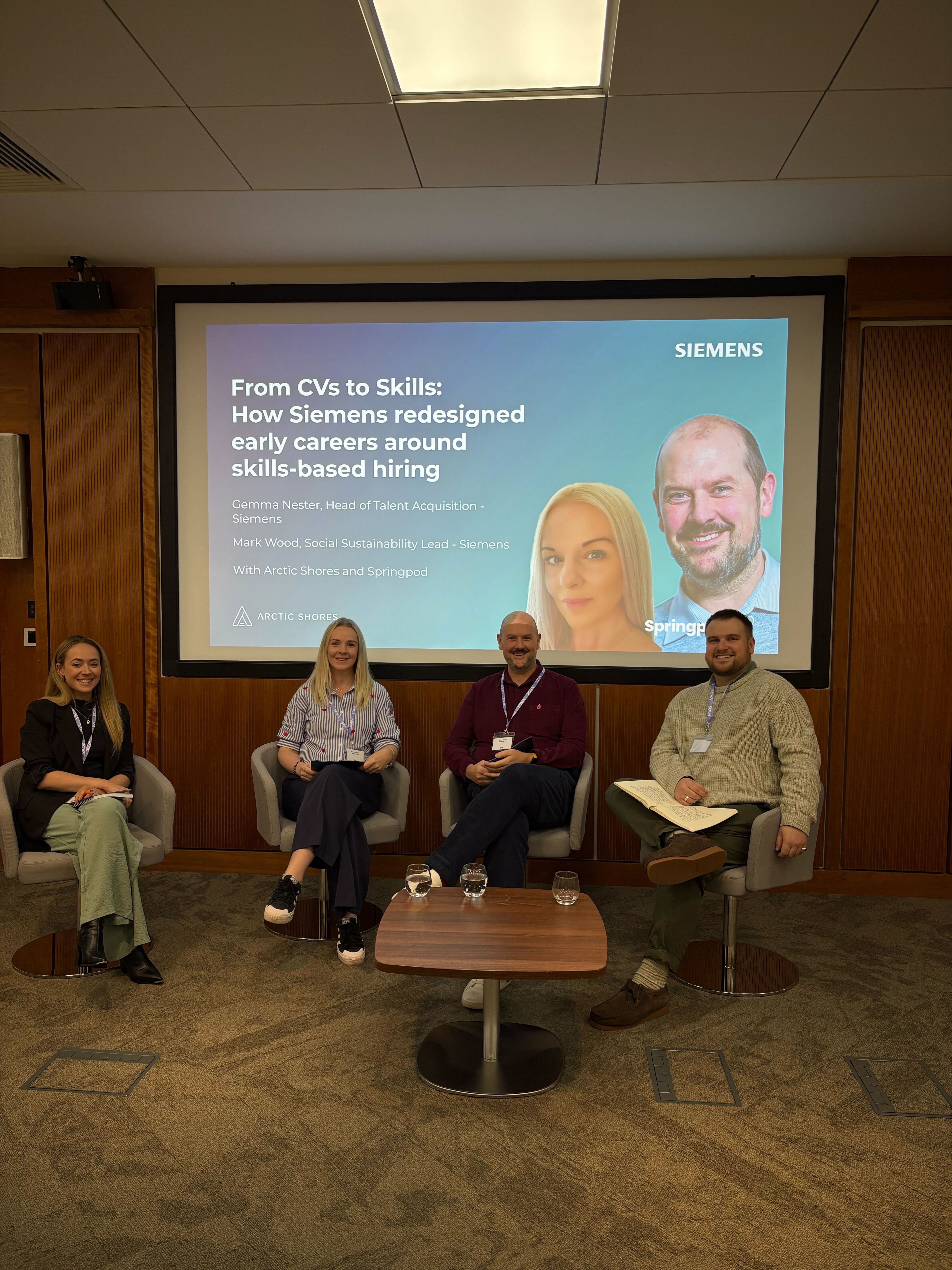
Mark Wood, Social Sustainability Lead at Siemens GB&I, talked about the reality of that. He found himself batting away many requests for work experience and business requests, simply because there wasn’t a clear framework or the right partners in place to do things differently. It was reactive and draining, rather than strategic.
All of that sat alongside a broader ambition around social sustainability. Siemens wanted early careers to play a strategic role in ensuring equity for all to be able to access opportunities and see a long-term future in the organisation.
So instead of making small tweaks, they decided to start again.
Designing a more circular approach to talent
Rather than viewing recruitment as a single moment in time, Siemens chose to see talent as a circular journey.
The story now starts well before an application form. With Springpod, Siemens has built an immersive digital space where students can explore what the company actually does, hear from real employees and start building skills that are relevant to work, not just school. For many young people, especially those without a family history in professional roles, this is the first time they genuinely picture themselves at an organisation like Siemens.
From there, candidates move into assessment experiences created with Arctic Shores. This is where the shift from “tell us” to “show us” really becomes clear.
Rather than asking young people to recite their skills, the process places them in realistic, task-based scenarios and pays attention to how they think, how they learn, how they respond to uncertainty and feedback. The focus is on underlying traits such as learning agility, resilience, problem solving and collaboration.
Jen Voyle from Arctic Shores used a simple image to explain this. Technical skills are the leaves on a tree: visible and important, but they constantly grow and fall away. Core human traits are the roots. If you hire for strong roots, you can grow the leaves you need as the business changes.
This behavioural lens also makes the process more resistant to the influence of generative ai. In a world where chatbots can write impressive CVs or score in the 98th percentile on some skills tests, Siemens has deliberately moved towards methods that are much harder to game and much closer to real work.
What this feels like for a candidate
It’s easiest to see the impact through individual stories. Henry’s journey is a prime example. He first encountered Siemens through a Springpod programme, where he could explore different roles, hear from employees and understand the culture behind the brand. That experience helped him see a place for himself in the organisation.
When he went on to apply, he wasn’t judged solely on the strength of his CV. Instead, he completed Arctic Shores’ assessment, which looked at how he approached tasks and challenges. The process surfaced his potential in a way a traditional sift might have missed.
Henry is now working at Siemens in an early careers role. His route into the business runs right through the partnership – from outreach, to assessment, to employment – and shows how a different model can open doors for people who don’t fit the usual mould on paper.
The impact in numbers, without losing the nuance
Behind the stories, there is data that shows the approach is working. Across a targeted Siemens programme, more than five thousand students have engaged, with around half completing the full experience. There is strong representation from girls and from students who identify as part of global majority backgrounds. Across wider pipeline activity, Siemens has reached well over a million young people and attracted thousands of applications for a relatively small number of early careers roles.
Crucially, diversity isn’t just a top of funnel story. Around half of final offers in a recent cohort went to female candidates. Candidate satisfaction is high. The team has also won back time, saving the equivalent of 150 working days a year in manual screening.
Underneath those numbers there’s a simple thread: when you broaden who you engage, then design assessments that recognise potential rather than polish, a different group of people start making it all the way through the process.
Early careers as a lever for social sustainability
What makes this partnership stand out is the way social impact and business value are treated as part of the same conversation.
For Siemens, early careers isn’t just a hiring pipeline. It’s a way to change who gets access to high quality work, who feels they belong in a technology led organisation, and whose perspectives shape the products and services they build.
By working with Springpod and Arctic Shores, Siemens has been able to design a system that reaches into schools and colleges, supports young people to prepare themselves, then assesses them in ways that are fairer and more predictive of long-term success. The same skills first mindset is now being applied to upskilling existing employees too, so the benefits are not confined to new joiners.
This is not about lowering standards. If anything, the expectations are higher. Candidates are being asked to show how they think and behave in situations that matter, rather than relying on neat wording in a CV. The difference is that more people get a fair chance to show what they can do.
What others can take from the Siemens experience
There’s no single template that every organisation can copy, but a few lessons come through clearly from the Siemens journey.
The first is that it helps to start with the outcomes you care about, rather than with the tools. Siemens began by asking what kind of workforce it needed for the future and what kind of social impact it wanted early careers to have. The processes and platforms followed from that.
The second is that it pays to treat the funnel as one joined up system. Outreach, assessment and development are now linked, rather than being run as separate projects. If something changes at the top of the funnel, the team looks at how that should ripple through to selection and progression, not just attraction.
The third is that iteration matters more than perfection. Siemens reviews its data regularly and is willing to adapt. Volumes change, business needs evolve and the early careers model moves with them.
The world of work is not going to become less complex any time soon. Skills will keep shifting. Ai will keep advancing. Expectations from candidates and regulators will continue to rise.
In that context, the organisations that thrive are likely to be those that hire for potential and build the skills they need, rather than simply hunting for the perfect CV. Siemens’ story shows that when you do that thoughtfully – and when you commit to inclusion as well as performance – you can build an early careers programme that is both fairer and more future ready.